
Vet Nurse Training
Progress Bar
The world is host to over 2,000 species of flea, and they’re a problem almost everywhere. Most common is Ctenocephalides felis, the "cat flea". Despite its name, the cat flea affects both dogs and cats, and wildlife such as possums - and can be unpleasant for pet owners, too.
When a flea jumps onto a pet, it will start feeding within 5 minutes and may suck blood for up to 2½ hours. Female fleas are the most voracious, consuming up to 15 times their own body weight in blood. And a single flea can live on a dog or cat for almost 2 months!
Experts in multiplication
Flea infestations can rapidly get out of control. That’s because fleas lay eggs in such large numbers. At a rate of 40 to 50 per day for around 50 days, a single female can produce 2,000 eggs. These eggs hatch into larvae and then develop into pupae. .
Huge numbers of newly developed pre-adult fleas can then remain dormant inside pupae or cocoons in homes for weeks to months. Only when conditions are right—a combination of heat, carbon dioxide and movement—will they emerge from these cocoons as young and hungry adult fleas, which will infest pets.
95% of a flea problem lives in the environment, adult fleas only account for 5% of an infestation.
Life cycle of a flea
Click through to learn more about each stage of the flea life cycle.

Eggs
Female fleas lay eggs while on your dog and can produce 40 to 50 eggs a day, leaving them to fall off your dog and all over your home. Each egg can hatch into larvae in as little as 1 to 10 days, and as many as 30% will develop into adults.
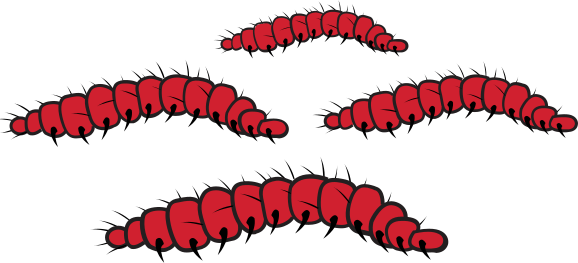
Larvae
Flea larvae live in carpets, fabrics, and small crevices in your dog’s environment. They feed on adult flea faeces and organic material they find until they’re ready to develop into pupae.

Pupae
Pupae develop into adult fleas inside tiny cocoons. Here they can stay dormant for long periods and come out in response to heat, carbon dioxide and movement.
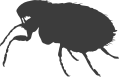
Adult Flea
Once on your pet, adult fleas spend the rest of their lives there, feeding and laying eggs that infest your home within a matter of days.
A threat that’s more than skin-deep
Simple itching caused by fleas can be irritating enough for a dog or cat. But fleas can cause more serious health problems too. Some pets develop severe allergies to flea bites (called flea allergy dermatitis) and develop signs, such as itching, that may last long after the fleas have gone. Fleas are also responsible for transmitting the dog tapeworm (Dipylidium caninum) to dogs, cats and even humans. In addition, fleas can spread bacterial diseases too.
Most dogs will pick up fleas often throughout their lifetime. Even pets that never go outdoors are at risk from fleas that can find their way into their home.
Getting fleas doesn’t have to be a big deal for owners and their pets, but it is important to catch and stop fleas early, before they multiply and become an even bigger problem. That’s why regularly checking for fleas should be part of routine pet care.
Always keep an eye out
Adult fleas can sometimes be easy to spot, particularly in short and light-coloured fur. They are more difficult to find in dark-haired pets. Also, pets may groom the fleas out before you have a chance to see them, so pets may have fleas, but you may not always see them.
Try parting the coat near the base of the tail using your hands or a flea comb and look for movement. Most fleas grow to about the size of a pinhead and will move or jump when disturbed.
Signs of fleas
Even if you don’t see any fleas, have a look for dark, pepper-like particles on the surface of your pet’s skin and coat. These may be ‘flea dirt’, which are flea droppings.
You can easily confirm this by dabbing some of this material with a wet paper towel or cotton ball. If you see dark reddish brown or orange swirls, this is flea dirt and confirms that the pet has fleas.

If you’ve had a flea infestation in your home, you’ll never want to have one again. To stop repeat infestations, you need to break the flea life cycle once and for all, for a successful attempt at getting rid of fleas.
It’s a sobering thought that for every flea on a dog or cat, there are probably at least nine more in the home environment. Pet owners may think they’ve accomplished getting rid of fleas, only to find a new generation emerging days to weeks after they’ve started treating their pet. This is because most pet owners don’t use insecticides year-round and once a flea infestation has been established it can take up to 8 or more weeks to eradicate it.
To avoid such situations, veterinarians and veterinary nurses should recommend using a flea product all year-round to break the flea life cycle. Every pet in the household should be treated at the same time to make sure the problem is tackled effectively. Choosing a product that kills adult fleas and breaks the flea lifecycle is also important.
Targeting flea hideouts
To reduce the number of flea eggs and larvae in a home:
- Wash all pet’s bedding in very hot water.
- Vacuum carpets and furniture to remove eggs and larvae and discard the vacuum cleaner bag.
By targeting all the hideouts at once, you help break the life cycle and keep the pet and house flea-free.

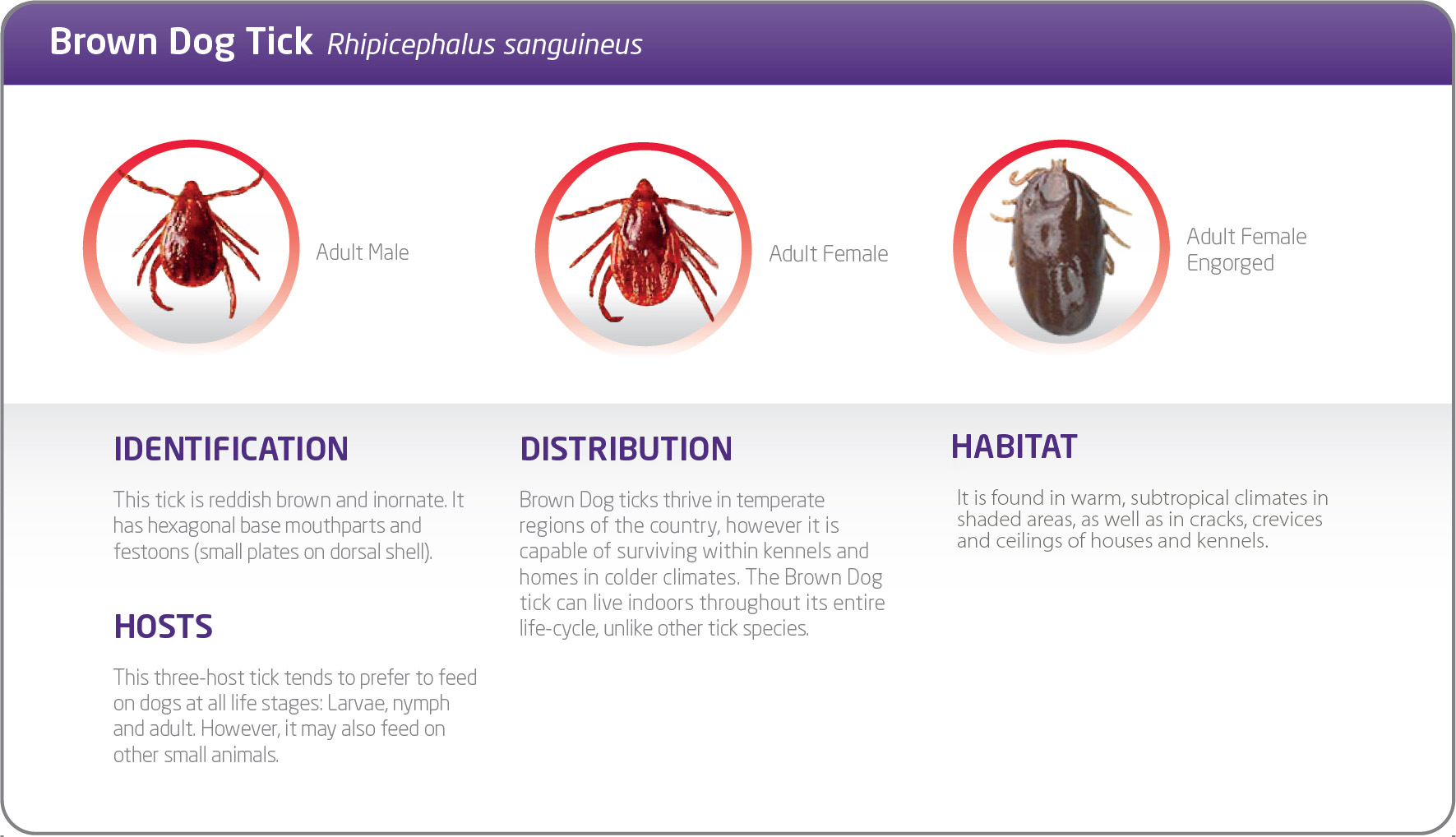
A tick is a small blood-sucking parasite that is related to spiders. There are many species of ticks, but in (South) East Asia the single most prevalent tick for pets is the brown dog tick (Rhipicephalus sanguineus). The brown dog tick is unusual among ticks, in that it can complete its entire life cycle indoors. Because of this, it can also establish populations in colder climates, and has been found in much of the world. Many tick species can be carried indoors on animals, but cannot complete their entire life cycle inside. Although R. sanguineus will feed on a wide variety of mammals, dogs are the preferred host and these are required to develop large infestations.
The tick life cycle
The brown dog tick is a 3-host tick; this indicates that it leaves the host to develop and molt between the larval, nymphal and adult stages. Each stage must locate a host; in a domestic environment this may result in feeding on the same dog (if there is only one or a few dogs present), but there is an opportunity for the same tick to feed on three different hosts.
A fully blood-fed female brown dog tick can lay up to 5000 eggs; the number of eggs laid depends on the size of the tick and the amount of blood she ingested. The length of time each stage feeds, and the time required for development and molting, are very dependent on temperature. Feeding and development times are generally faster at warmer temperatures. Survival is generally higher at cooler temperatures and higher relative humidity, but these ticks are tolerant of a wide range in conditions. An adult female will feed on the host for around one week, then drop off the host and find a secluded place for egg development. Cracks and crevices in houses, garages and dog runs are ideal locations. She will start laying as soon as four days after she completes feeding and drops off the host, and can continue to lay for as long as 15 days. As she lays the eggs, she passes them over her porose areas (specialized areas on the back of the basis capituli), to coat them in secretions which protect the eggs from drying out. After she finishes laying her eggs, she dies. The larvae hatch two to five weeks later, and begin to quest, or look for a host.
Life cycle of a brown dog tick
Click through to learn more about the life cycle of the brown dog tick:
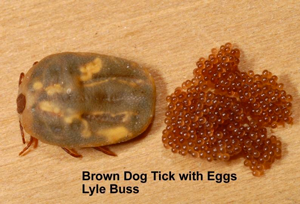
Tick Eggs
A single female brown dog tick can lay up to 5,000 eggs at a time.
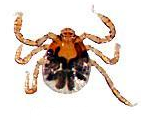
Larvae
Ticks hatch as six-legged larvae after an incubation period of 40 to 60 days. Larvae search for a blood meal from a host, feed for four to six days, then drop from the host and moult to become an eight-legged nymph.
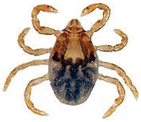
Nymph
Nymphs require a second blood meal on a host before they can moult again to become an adult.
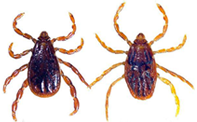
Adult
Female adults then require a further blood meal of up to ten days before dropping off a host to lay up to 3000 eggs in leaf litter. Male adults will search for females on the host for mating, and to parasitise the females for blood meals. This life cycle takes around a year to complete.
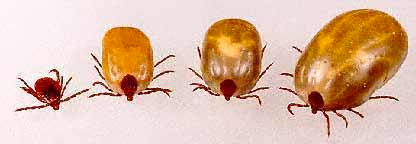
All stages of this tick prefer dogs, although they will feed on other mammals. Larvae feed for three to seven days, then take about two weeks to develop into nymphs. The nymphs then feed for five to 10 days and again take about two weeks to develop into adults. As adults, both males and females will attach to hosts and feed, although the males only feed for short periods. The overall cycle can be completed in just over two months, but frequently will take longer if there are few hosts available or in cold temperatures. Ticks are notoriously long-lived, and can live as long as three to five months in each stage without feeding. Frequently, people report having different types of ticks, or adults and "babies". In fact, generally what they are seeing are engorged and unengorged ticks or different stages. Ticks increase in size dramatically while feeding; engorged ticks are considerably larger than unengorged ticks. The different stages (larva, nymph and adult) are progressively larger in size. Many features used to identify the stages and sexes are difficult to see without a microscope. Larvae have only six legs, while nymphs and adults have eight. Males and females are difficult to distinguish without examining them microscopically, but males take only small blood meals while females take large meals and increase in size. Nymphs are distinguishable from adults primarily by size, but this is not reliable and needs to be confirmed by microscopic examination.
How to check a dog
There is no quick way to check a dog for ticks, as a tick that has had ample time may have burrowed down through the fur to the skin and attached itself.
Ticks are very small before they have started to feed, and are easy to miss without a thorough examination. Once ticks are engorged with blood they are larger and easier to feel and spot.
Removing ticks from dogs
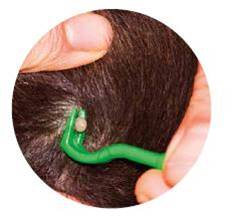
Use tweezers, finger nails or a tick-removing device to grasp the tick as close as possible to the dog's skin, and slowly but firmly pull it away from the skin, trying to keep the tick intact.
If the mouthparts of the tick happen to stay in the skin, they may be gently scratched out with a fingernail.
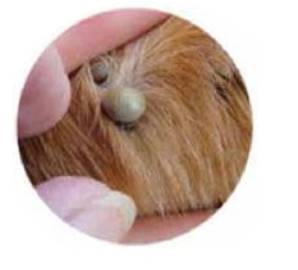
No matter how careful you are, ticks may still manage to land on you or your dog because they are extremely well adapted to hide in the environment, detect approaching hosts, and hitch a ride. As well as physically checking their dog, pet owners should always use preventative treatment during the tick season which may be year-round in many Asian countries.
Engorging ticks:
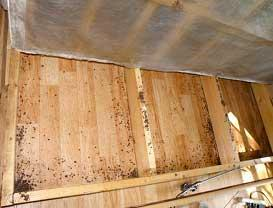
Brown dog ticks in the environment:

Bravecto (Fluralaner) is an isoxazoline - a new innovative class of parasiticides.
- Never before used for flea control.
- No known resistance.
- Effective against fipronil resistant strains.
Bravecto delivers rapid, consistent and long-lasting efficacy against both fleas and ticks.
Bravecto chewable tablets provide:
- Treatment and control of Flea (Ctenocephalides felis) infestations for 12 weeks.
- Treatment and control of Brown Dog Tick (Rhipicephalus sanguineus) infestations for 12 weeks.
Bravecto:
- Provides effective flea control within 8 hours.1,2
- Maintains effective control within 8 hours, throughout the 12 week treatment interval.1,2
- Delivers rapid onset of action to kill newly emerged fleas before they lay eggs.1
Proven performance in Australian conditions
An Australian pen study1 assessing the performance of Bravecto to remove and control artificial infestations of adult cat fleas on dogs, displayed ≥ 99.9% efficacy throughout the 3 month trial.
1. MSD data on file.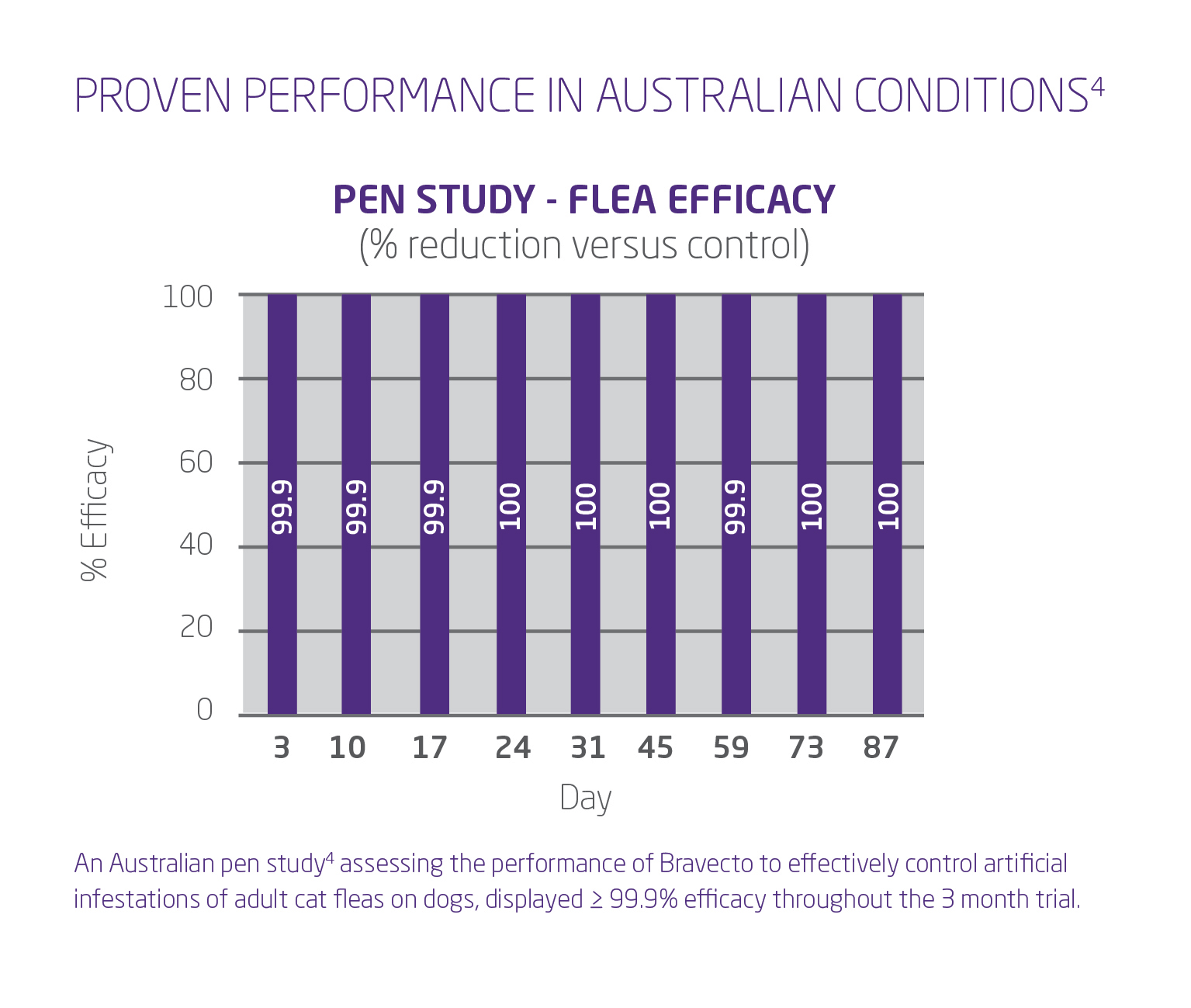
2. Taenzler J, Wengenmayer C et al. Onset of activity of Fluralaner (Bravetco™) against Ctenocephalides felis on dogs. Parasites & Vectors (2014) 7:567.
- Bravecto can be used in puppies from 8 weeks of age weighing greater than 2kg.
- Bravecto has been shown to be well tolerated in puppies when tested at up to 5X the highest recommended clinical dose (i.e. 5x56mg = 280mg fluralaner/kg BW) on 3 occasions at 8-weeks intervals.1
- Bravecto can be used in breeding, pregnant and lactating dogs.1
- Bravecto is well tolerated in MDR1 gene deficient collies.2
- During clinical field testing, no interactions between Bravecto and routinely used medicinal products were observed. 1,3,4,5

2. Walther FM, Allan AJ, Allam MJ et al. Safety of fluralaner, a novel systemic antiparasitic drug, in MDRI(-/-) Collies after oral administration. Parasites & Vectors (2014) 7:86.
3. Rohdich N, Roepke R, Zchiesche E. A randomized, blinded, controlled and multi-centered field study comparing the efficacy and safety of Bravecto™ (fluralaner) against Frontline™ (fipronil) in flea and tick-infested dogs. Parasites & Vectors 2014 7:83.
4. Meadows C, Geurino F and Sun F. A randomized, blinded, controlled USA field study to assess the use of fluralaner tablets in controlling canine flea infestations. Parasites & Vectors (2014) 7:375.
5. Walther FM, Fisara P, Allan MJ et al. Safety of concurrent treatment of dogs with fluralaner (Bravecto™) and milbemycin-oxime-praziquantel. Parasites & Vectors (2014) 7:481.
Extending client satisfaction and quality of care can mean better compliance
- A highly palatable, easy to administer chew - studies show more than 91.7% of dogs accept Bravecto voluntarily.1,2
- Bravecto's extended protection periods mean clients have few treatments to remember each year, therefore less to forget.
- No mess to administer, no liquids to spill or transfer.
- Full year flea protection in just four sequential doses - protection at every season. Fits easily into gastrointestinal worming programs where treatments occur every 3 months.

2. Meadows C, Geurino F and Sun F. A randomized, blinded, controlled USA field study to assess the use of fluralaner tablets in controlling canine flea infestations. Parasites & Vectors (2014) 7:375.

- Within each weight range, a whole tablet must be used. For dogs weighing more than 56kg use a combination of tablets that most closely matches the bodyweight.
- Administer Bravecto at or around the time of feeding for maximum effectiveness.1
- In dogs older than 8 weeks, treatment every 8 weeks has been shown to be well tolerated.
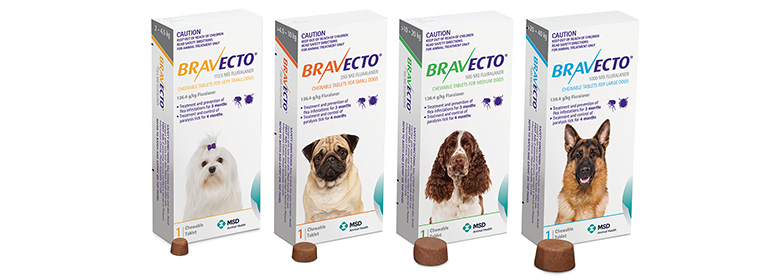
Easy to merchandise in single dose packs
Q. Can Bravecto be used in breeding / pregnant / lactating
dogs?
Yes. Bravecto is approved for use on in breeding, pregnant and lactating
dogs.
Q. Does Bravecto help manage flea allergy dermatitis?
Yes. Bravecto reduces the incidence of flea allergy dermatitis (FAD) by
controlling adult fleas. Bravecto can also be used as part of a treatment
strategy for FAD.
Q. Is Bravecto effective against other dog parasites (e.g.
mosquitoes / flies / mites / lice / nematodes)?
Yes. Efficacy against mites (demodex, sarcoptes and otodectes) has been
published.
Q. Can I give Bravecto to cats?
Bravecto chew is not approved for use in cats. Some countries now have
Bravecto Spot-on for cats approved.
Q. What pack sizes does Bravecto come in?
Bravecto is available in single dose packs, one dose provides 12 weeks
months protection against fleas and ticks.